
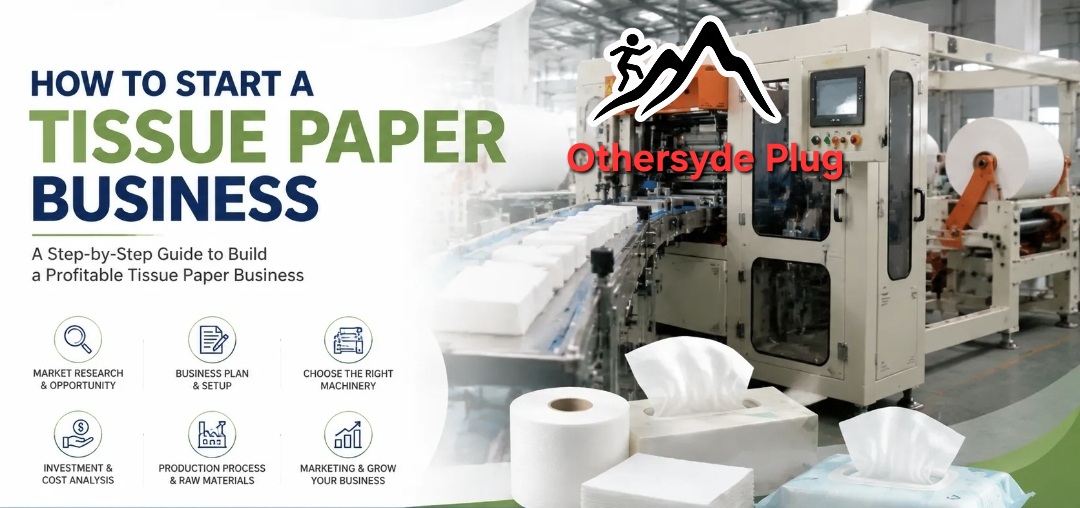
Written by: OtherSyde Group
Editorial focus: Practical business setup, manufacturing and entrepreneurship
Experience note: OtherSyde Group shares practical knowledge from building and managing businesses and digital projects. This guide is intended to help a first-time entrepreneur understand the decisions involved before investing money.
Introduction
A tissue paper business can be started in different ways. You do not necessarily need to build a paper mill from day one.
For a new entrepreneur in Johannesburg, there are three practical models to consider:
- Buy and resell finished tissue products
- Buy bulk tissue and convert/repackage it under your own brand
- Manufacture tissue from paper jumbo rolls using industrial converting equipment
The important decision is choosing a model that matches your available capital, experience and customers.
Johannesburg already has businesses operating around paper, tissue and packaging, which means there is an existing supply ecosystem you can investigate. For example, local listings include tissue manufacturers, paper distributors and packaging suppliers. TTPG-SA Toilet & Tissue Paper Factory, Peters Papers (PTY) LTD and Express Packaging Suppliers are examples of businesses you could research and compare as part of your supplier investigation.
1. Choose Your Business Model
Don’t buy machinery before deciding how you will make money.
| Model | Capital requirement | Control | Difficulty | Good for |
|---|---|---|---|---|
| Reselling finished tissue | Lower | Low | Low | Beginners |
| Private-label/repackaging | Medium | Medium | Moderate | Building a brand |
| Tissue converting | Higher | High | High | Established businesses |
| Full paper manufacturing | Very high | Very high | Very high | Industrial operation |
For a beginner, distribution or private-label tissue can be a more practical starting point than immediately purchasing industrial manufacturing equipment.
You can first prove that customers will buy your product.
2. Decide Who Your Customers Will Be
Tissue is a repeat-purchase product, which creates an interesting business opportunity.
Potential customers include:
- Small supermarkets
- Spaza shops
- Restaurants
- Takeaway businesses
- Schools
- Offices
- Guesthouses
- Cleaning companies
- Churches
- Events companies
- Wholesalers
- Households
Don’t try to sell to everyone immediately.
For example, you could build a business supplying small shops in Johannesburg with affordable toilet tissue in bulk.
Your business model becomes clearer:
Supplier → Your business → Local shops → Customers
3. Start by Testing Demand
Before buying machinery, speak to potential customers.
Ask shop owners:
- Which brands do they currently buy?
- How many packs do they purchase?
- What price range sells?
- Do customers prefer 1-ply or 2-ply?
- What pack sizes move fastest?
- Would they consider a new local brand?
- How often do they reorder?
This information is more useful than guessing what the market wants.
A Simple Test
Suppose you approach 20 local shops.
If only one shop is interested, don’t immediately buy machinery.
If several shops want samples and prices, you have evidence that further testing may be worthwhile.
4. Find Tissue and Packaging Suppliers
Johannesburg has a number of paper, tissue and packaging businesses that you can investigate.
For example:
- TTPG-SA Toilet & Tissue Paper Factory — tissue-paper manufacturer in West Turffontein.
- Peters Papers (PTY) LTD — paper distributor in Heriotdale.
- Converted Paper Products JHB (Pty) Ltd — paper/stationery manufacturing business in Heriotdale.
- Express Packaging Suppliers — packaging supplier in Johannesburg.
- Noble Tissue Brands — tissue manufacturer in Industria West.
These are examples to investigate, not endorsements. Contact suppliers directly, request quotations and compare product specifications, minimum quantities, quality and delivery terms.
5. Compare Before Buying
Never choose a supplier simply because their quotation is the cheapest.
| What to compare | Why it matters |
|---|---|
| Tissue quality | Determines customer satisfaction |
| Ply | Affects product positioning |
| Sheet size | Affects value and cost |
| Roll size | Determines packaging and pricing |
| Minimum order | Affects cash flow |
| Delivery | Affects your final cost |
| Packaging | Influences presentation |
| Private labelling | Important for your own brand |
| Payment terms | Affects working capital |
| Defective goods policy | Protects your business |
Ask for samples before placing a large order.
6. Consider Your Own Brand
If you want to build a long-term business, you could eventually create your own tissue brand.
Your packaging can communicate:
- Brand name
- Ply
- Number of rolls
- Sheet information where applicable
- Manufacturer/distributor details
- Customer contact information
- Relevant product information
Your brand should not make claims that you cannot substantiate.
A premium tissue brand needs a reason for customers to pay more. A budget brand needs efficient sourcing and distribution.
7. If You Want to Manufacture
Manufacturing requires a much larger commitment.
Depending on the product, a converting operation can involve equipment such as:
- Jumbo-roll tissue
- Rewinder
- Perforation system
- Embossing equipment
- Cutting equipment
- Core-making equipment
- Packaging equipment
- Storage
- Material-handling equipment
The exact machinery depends on the type of tissue product you intend to produce.
Before buying equipment, obtain quotations from multiple machinery suppliers and ask about installation, training, maintenance, spare parts, electricity requirements and production capacity.
The machine’s advertised production capacity should not be treated as your guaranteed sales volume.
8. Register the Business
If you establish a company in South Africa, CIPC is the relevant company-registration authority. SARS states that companies must register with CIPC before the tax-registration process, with tax administration then handled through SARS.
CIPC’s BizPortal currently provides online company-registration and related services.
Your exact tax obligations depend on how your business is structured and its activities. SARS also provides information on small-business taxation, including turnover tax and VAT.
Do not assume that a small manufacturing business has no regulatory obligations. If you manufacture, employ people, import materials or operate industrial equipment, investigate the requirements applicable to your specific operation.
9. Calculate the Real Cost
Your calculation should go beyond the cost of tissue.
For example:
Product + packaging + transport + storage + labour + electricity + equipment + wastage + marketing + administration = total business cost
Then calculate your selling price.
| Business question | What you need to know |
|---|---|
| Cost per pack | Actual landed/production cost |
| Wholesale price | What shops will pay |
| Retail price | What consumers may pay |
| Gross margin | Money remaining before other expenses |
| Monthly overhead | Fixed business costs |
| Break-even point | Sales needed to cover costs |
This calculation can tell you whether the business makes sense before you commit significant capital.
OtherSyde’s Practical Perspective
If I were starting a tissue business in Johannesburg from scratch, I would not begin by buying a large tissue machine.
I would first find customers.
I would approach shops, restaurants, cleaning businesses and other potential buyers, understand what they currently purchase and obtain supplier quotations.
Then I would test a small batch.
If customers repeatedly reorder, I would gradually move toward greater control over production and branding.
That approach reduces the risk of owning expensive machinery while still trying to discover whether there is a market.
The machine should follow the business opportunity—not the other way around.
Where to Find Related Information for Verification
For company registration and tax requirements, verify the latest information directly through CIPC and SARS. SARS provides current guidance on starting a business, tax registration and small-business tax obligations.
For suppliers in Johannesburg, compare at least three quotations and request samples before committing to a large purchase.
When considering imports, check SARS Customs requirements. SARS states that persons importing goods into South Africa are subject to importer-registration requirements.
For machinery, obtain specifications directly from manufacturers and compare warranty, installation, technical support, spare parts and operating requirements.
Conclusion
Starting a tissue paper business in Johannesburg can begin much smaller than many people assume.
You can start as a distributor, move into private labelling, and eventually consider tissue converting when your sales justify the investment.
The most important first step is not buying a machine. It is proving that customers will repeatedly buy your product at a price that leaves your business with a sustainable margin.
This OtherSyde Group guide is designed to give first-time entrepreneurs a practical starting point. Supplier prices, business requirements, tax rules and machinery specifications can change, so verify those details with the relevant supplier or official authority before investing.
Start with the customer, test the product, calculate the numbers, then scale.